
SAFARI & TOUR OF ADDO ELEPHANT IN SOUTH AFRICA
Learn More On AfricanMecca Safari Tier Ratings & Experiences For South Africa
CONTACT AN EXPERT ON ADDO ELEPHANT SAFARIIntroduction To Addo Elephant National Park
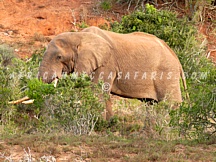
Deep within the shadows of the dense valley bushveld of the Sundays River region of the Eastern Cape lies the Addo Elephant National Park. Here, the evenings are punctuated by the strident howl of the black-backed jackal, and the francolin's call heralds each new dawn. Safe from relentless persecution in the past, the grey leviathans of the bush now roam in peace. The original Elephant section of the park was proclaimed in 1931, when only eleven elephants remained in the area - today this finely tuned ecosystem is sanctuary to over 450 elephants, Cape buffalo, black rhino, a variety of antelope species, as well as the unique flightless dung beetle, found almost exclusively in Addo. And their Addo has only just begun. with plans to expand the 164000 hectares Addo National Elephant Park into a 360 000 hectares mega-park. In addition, plans include the proposed proclamation of a 120 000 hectares (296 500 acre) marine reserve that includes islands that are home to the world's largest breeding populations of Cape gannets and second largest breeding population of African penguins.
The Wildlife & Ecology Of Addo Elephant
Addo Elephant National Park Mammals
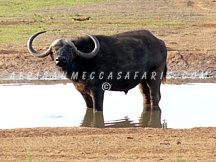
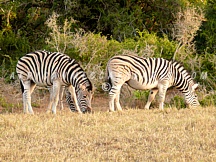
This park offers some of the most spectacular elephant viewing in the world. Addo's over 450 elephants will delight visitors with their antics. The park contributes to the conservation of the endangered black rhino with over 48 of these animals occurring here. The over 400 Cape buffalo are now being seen more often during the day due to the influence of lion reintroduction. This is one of the largest disease-free herds in South Africa. Six lions were introduced into the park in late 2003 and have adapted well to their new environment. Lions are most often seen in the early morning or on sunset and night drives. Spotted hyenas were also reintroduced in 2003, fulfilling the same role as lions in restoring the natural balance to the ecosystems in the park by controlling the numbers of herbivores. Leopard are very seldom seen, being shy and secretive animals, but do occur in most areas of the expanded park. Antelope species abundant in the main game area of the park include red hartebeest, eland, kudu and b ushbuck.The Burchell's zebra, many with the pale rumps reminiscent of the extinct qwagga, occur in the park. The outlying areas of the park have very different animals on offer: The Zuurberg mountain range is home to the Cape mountain zebra, mountain reedbuck, baboons, blue duiker, aardwolf and red rock rabbit.Hippos are found in the Sundays River which flows at the base of these mountains. Endemic fish such as the red fin minnow and yellowfish are found in the tributaries of the river. Gemsbok, black wildebeest, springbok, buffalo and black rhino are found in the arid nama-karoo around the Darlington Dam area. Once this area has been consolidated, cheetah and wild dog will be introduced. The coastal forest is home to bushbuck, bushpig, brown hyena and the rare tree dassie.
Addo Elephant National Park Birdlife
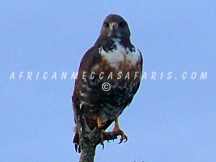
Addo's birding opportunity covers excellent habitat contrasts between dense thickets of spekboom interspersed with open grassy areas and wooded kloofs (particularly in the Zuurberg region). Now that the park has expanded to include Darlington Lake , Woody Cape , the coastal islands and the Alexandria Forest , a variety of other habitats swell the birding potential of the park. In and around the Addo rest camp Karoo Scrub Robin and Cape Robin-Chat, Bokmakierie, Southern Tchagra, Bar-throated Apalis and Cape Bunting are prominent, with Brown-hooded Kingfisher, Fiscal Flycatcher, Fork-tailed Drongo, Spectacled Weaver, Malachite and Greater Double-collared Sunbird also easily found. A trip into the game viewing area will not produce a plethora of birds, but Bokmakierie will once more be prominent, and Martial Eagle, Black Korhaan, Blue Crane, Denham's Bustard, Black-headed Heron and Secretarybird may well be seen. In the wooded kloofs of the Zuurberg, African Crowned Eagles breed. Forest species typical of the Eastern Cape, such as Olive Bush Shrike, Yellowthroated Woodland-Warbler and Cape Batis can also be searched for. Alexandria Forest has many forest species, such as Knysna Turaco, Black Cuckoo (summer only), Grey Cuckoo-shrike, Chorister Robin-chat, Dark-backed Weaver and the spectacular Narina Trogon. The coastal grasslands South of Alexandria Forest are home to exciting species such as Denham's Bustard (with impressive displaying during summer) and Black-winged Plover. The coastal islands have impressive breeding colonies of Cape Gannet and African Penguin and it is one of the few South African breeding locations for Roseate Tern.In the summer months at the Sundays River Mouth there are large tern roosts that include Swift, Sandwich, Common Terns and the diminutive Damara Tern which breed in the nearby sand dunes.
Addo Elephant National Park Vegetation
Addo's vegetation is remarkable because in a relatively small area, five of South Africa's biomes are found. (Much larger parks such as Kruger National have only one biome). Biomes can be defined as the major communities of the world, classified according to their predominant vegetation and characterized by adaptations of organisms to that particular environment. Biomes are characterized by a similar association of species, comparable climates, and consistent soil types. The original Addo-Elephant area is mainly covered by subtropical thicket (also known as valley bushveld), characterized by impenetrable Spekboom. It was this vegetation that protected the last remaining elephant and buffalo from being wiped out by hunters. The Zuurberg Mountains harbour deep wooded kloofs and streams. In the exposed higher altitude areas, grassland and fynbos are found. Moving inland over the mountains the area around Darlington Lake turns to succulent Karoo-type (arid semi-desert) vegetation known as Noorsveld. On the seaward side of the original elephant section the Woody Cape section contains a remarkable display of coastal dune-fields and coastal grassy plains. Moving east the Alexandria Forest is an excellent example of pristine temperate forest.
Addo Elephant National Park Activities
- Guided Game Drives
- Horse TrailS
- Selected Hiking Trails In Alexandria & Zuurberg
- Bird Watching
The park conserves no less than five of South Africa's seven biomes Home to one of the densest African elephant populations on earth It is home to the unique flightless dung beetle. Addo incorporates the largest coastal dune field in the southern hemisphere. The park boasts the Big Seven (elephant, rhino, lion, buffalo, leopard, southern right whale, great white shark). It also protects the world's largest Cape gannet breeding population on Bird Island.
History Of Addo Elephant National Park
In the early centuries, when great herds of wild animals roamed the Addo region, the Khoesan of the Iqua, Damasqua and Gonaqua clans lived in the area. They hunted and kept cattle but tragically were largely wiped out in the 1700s by the smallpox epidemic. Nomadic Xhosa tribes had kraals in the area, including Chief Cungwa of the Gqunukhwebe (near the Sundays River mouth and inland) and Chief Habana of the Dange (near the Wit River). The Addo Elephant National Park (AENP) was proclaimed in 1931 to protect the remaining 11 Addo elephants. The great herds of elephants and other animal species had been all but decimated over the 1700s and 1800s by hunters. In the late 1800s, farmers began to colonise the area around the park, also taking their toll on the elephant population due to competition for water and crops. This conflict reached a head in 1919 when farmers called on the government to exterminate the elephants. The government even appointed a Major Pretorius to shoot the remaining elephants. He shot 114 elephants between 1919 and 1920. Public opinion then changed, leading to the proclamation of the park in 1931. The original size of the park was just over 2 000 hectares. Conflicts between elephants and farmers continued after proclamation as no adequate fence enclosed the park. Finally in 1954, Graham Armstrong (the park manager at the time) developed an elephant-proof fence constructed using tram rails and lift cables and an area of 2270 hectares was fenced in. There were 22 elephants at the time. This Armstrong fence, named after its developer, is still used around the park today. Although the park was originally proclaimed to protect a single species, priorities have now changed to conserve the rich biological diversity found in the area.
Addo Elephant Camp & Lodge Accommodations In South Africa
AFRICANMECCA REVIEWS
What are our Customers saying about our safari holidays?
On behalf of myself, my wife and my two adult daughters, I want to sincerely thank you and AfricanMecca Safaris for our fabulous recent safari. Everything you promised exceeded our expectations and was superb, which is saying a lot since this was our second trip, having had a wonderful Botswana Safari 10 years ago. Do not ever hesitate to use me as a reference.
Robert Schenkein - prVision Photography Studio - Colorado, United States
Chobe was delightful, less than half full. Sussi and Chuma, very nice, again only 13 people in all. All the game drives and river cruises were excellent. We had great weather. The ability to get really close is in inspiring. EVERYWHERE we went, the people were warm, helpful and charming. Thank you so much. We will be recommending your services to all.
Thomas Kelch - California, United States
Raza Visram at AfricanMecca planned the most amazing trip for my friend and I. I wanted to go to 4 countries in 15 days and he made it happen. It was an aggressive itinerary and Raza planned it so well, that the transitions were seamless. The last leg of the trip was Botswana for another Safari and we stayed at the most beautiful lodge. The excitement in seeing the animals so closely is indescribable.
Karin Alsdorf - New Jersey, United States
I had a wonderful trip to Africa and I would highly recommend your company.I have been to Africa many times and I have never had such wonderful service. The guide and safari vehicle were both great and all the lodges were outstanding. We will be going to Africa again the year after next and I assure you I will be contacting you. Thanks again for arranging such a great trip.
Ronald Price, President, Ron Price Motors Group - California, United States
Greetings to you and our most fervent thanks for a wonderful trip of Kenya, Zanzibar, South Africa & Victoria Falls. This was truly a perfect vacation. Thank you so much for all your arrangements. It was a trip filled with different kinds of adventures. We experienced and learned so much. Would highly recommend it to others who are interested in similar trips. Wishing you the very best.
Adrienne & Barrie Carter - Canada
Thank you for everything; we had an amazing honeymoon. Words really can't describe our experience, all we can really say was that it was the most amazing experience of our lives and we would recommend AfricanMecca to anyone. We hope to visit Africa again sometime next year! Thank you & all of your staff for an amazing & perfect honeymoon.
Rick Sagoo - London, United Kingdom
CONTACT AND TALK TO OUR SOUTH AFRICA TOUR EXPERTS TODAY TO START YOUR TRIP PLANNING PROCESS
Request South Africa Custom Or Tailor-Made Safari Vacation Pricing Based On Your Specific Travel Dates At Your Preferred Safari Tier Lodge Or Camp
CONTACT AN EXPERT ON SOUTH AFRICA SAFARI PRICES & TOURS