
Understand Safari Tier Ratings & Experiences In South Africa | Why Visit South Africa For Your Safari Vacation Or Holidays In Africa
SWAZILAND KINGDOM WITHIN SOUTH AFRICA
Swaziland Location
Situated in Southern Africa, the Kingdom of Swaziland is landlocked in the east by Mozambique and on the other borders by South Africa. It has a subtropical climate with summer temperature of 15 degrees to 25 degrees Centigrade and 15 degrees to 19 degrees in winter. The rainfall at higher altitudes varies from 1000 to 1600mm while in the lower areas it is between 500 and 600mm. The country’s highest point is Emlembe at 1862m and the lowest at the Usuthu River at 21m. The country has a wide range of habitats and great variations in flora and fauna.
Swaziland Capital
Mbabane is the administrative capital, with a population of 60 000. Manzini is the hub, situated next to Matsapha Industrial Estate. The population of Manzini is about 80 000. Lobamba is the legislative capital.
Swaziland Language
Siswati and English are the official languages although English is used extensively in government and business. Siswati is used every day by the majority of the population.
CONTACT AN EXPERT TO PLAN YOUR SWAZILAND TOUR

Swaziland History
It is clear that the land, which is now the Kingdom of Swaziland has been inhabited since the Stone Age. There are also relics of nomadic bushmen, of Sotho and the Ntungwa-Nguni clans. Centuries ago, a great migration from Central Africa occurred. Asub-group known as the Nguni, which today includes the Zulu and Xhosa, branched off from the main stream of this movement to follow the East Coast. The first steps towards the creation of the Swazi Nation were taken around 1750 when NqwaneIII led his people inland to settle in, what is now, Southern Swaziland. Ngwane absorbed, or drove out, other people to establish himself in this area. His successor, Sobhuza I was troubled with raids by the Zulu’s to the south and re-established his capital near present-day Lobamba which has remained the heartland of the Nation.Mswati II succeeded Sobhuza I and inherited a Kingdom twice the size of Swaziland today. Still troubled by the quarrelsome Zulu’s, he established his capital at Hhohho, in the northern mountains, conquered territories as far afield as Carolina, Barbeton and Hectorspruit and welded his people into a nation. They were known as the people of Mswati-Mswazi to the Zulu’s, hence the name”Swazi” today.
During the 1840’s white adventurers – hunters, traders, cattlemen, missionaries, began to arrive in the area. They were received peacefully by the Swazi’s but, during the reign of Mbandzeni, it became clear that many of them were simply fortune-hunters, greedy for land and trading concessions. Then, in the late 1800’s, both the Boers of the old South African Republic and the British sought administrative domination over the Kingdom. This was a confused period where little was done to resolve the problem of the fortune-hunters and the present Northern, Western and Southern borders of the country were defined without reference to the Swazi’s. During the Anglo-Boer War, in 1899, King Sobhuza II was born and after the death of his father, Bhunu, his grandmother, Labotsibeni, assumed the Regency until the King came of age. After the war, Britain ruled Swaziland for 66 years as a Protectorate. Upon ascending the throne, Sobhuza II continued his mother’s struggle with the British to recover land, belonging to the Swazi Nation, which had supposedly been ceded to concession holders by King Mbandzeni during the 1800’s. A system of dual control persisted; the British Resident Commissioner and his district officers, on the one hand, and the King, the National and Inner Councils, and the local chiefs, on the other. However, constitutional changes suggested by Kin g Sobhuza II in the years leading up to Independence in September 1968 were eventually accepted. After Independence, it was recognised that the Constitution, created with western thinking by the British, did not suit the traditional needs of Swazis. King Sobhuza II ruled Swaziland from 1921, when he ascended the throne, until his death in 1982. His long rule is remembered for the wisdom of his insistence on the maintenance of traditional tribal values at a time of modern development. In 1986 King Mswati III was crowned as the predecessor of his late Father. Currently the country is at the reign of King Mswati III.
Swaziland Royal Kingdom
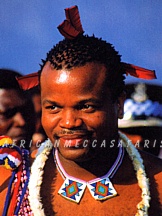
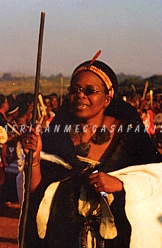
The successor to the throne is chosen in relation to the status of his mother. A Queen Mother is selected because of her high rank, however, the Queen Mother will be chosen by the Royal Council after the King’s death, she will be from an unrelated family. The Royal family line, the Dlamini’s, never intermarry; the King is always a Dlamini, the Queen Mother is never a Dlamini. The Queen Mother may have only one son, as a king is not to be followed by blood brothers. He is “Nkosi Dlamini” and is expected to unify his position by choosing wives from all sectors of the community. The balance of power lies between the King and the Queen Mother; the “Ngwenyama” represents the hardness as expressed in thunder, the Queen Mother or “Ndlovukazi” (The Elephant) the softness as in water. They assist and advise each other in many activities, each complementing the other. The Royal Council plays a key role in the selection of the successor to the throne. He must be single and if still a minor, the Queen Mother to the late automatically assumes responsibility of Regent until the prince is crowned “Ngwenyama”. The present Queen Mother, Queen Ntombi ruled as Queen Regent until King Mswati lll was crowned in April 1986.
Swaziland Traditions and Customs
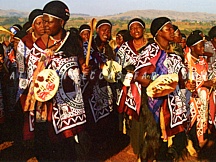
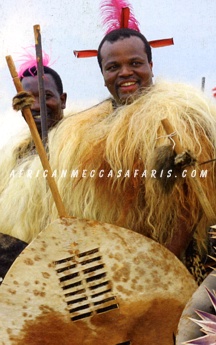
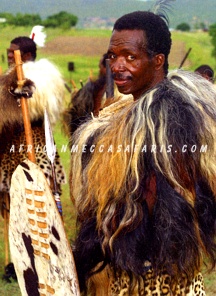
As with many developing countries, Swaziland presents a mixture of traditional customs and modern practices. But the old ways are retained and result in the traveller being greeted by people who are courteous, friendly and proud to be Swazi. So it is that the visitor will often see Swazis dressed in the “mahiya” the colouful national costume, often complemented with a shield, knobsticks and, sometimes, spears. Married women may still wear the traditional “beehive” hair style. Some swazis have embraced Christianity which in not necessarily in conflict with traditional beliefs. The latter involves a belief in Mkhulumnchanti – he who was there before everything else – and in life after death. Family ancestors are respected and are considered to continue to play in the life of the family. The rites, rituals and customs which preserve the traditional rules prescribe codes of social behaviour through every stage of person’s life. They provide practical solutions to many problems which bedevil societies elsewhere. From the youngest age, Swazi children are required to contribute to activities of the family group. Small boys herd the cattle; young girls have domestic chores or must care for younger brothers and sisters. An important attitude, which is taught from an early age, is respect for the child’s elders. Chastity is considered most important amongst Swazi girls and there are strict rule governing courtship. Marriage involves lobola; a dowry or gift to the brides parents; payable by the groom. This payment is usually in the form of cattle; in Africa cattle are traditionally considered to be wealth, and the number of cattle paid by the groom denotes the status of the family.
The Lobola creates an asset within the marriage and, although custom does not recognize divorce, serves as a settlement factor in the unlikely event of the marriage being dissolved. For exa mple, if the wife has returned to her family with a serious offence such as adultery, the lobola must be returned to the groom. A new bride will customary care for a child from the bridegroom’s family group. She will have charge of this adopted child until she has children of her own. In this way, the bride gains immediate acceptance into her new family and will be closely involved with them even if she does not fall pregnant straight away. At every stage of Swazis life; infancy; adolescence; puberty; marriage; and adult life; and the old age; there are traditional customs to guide the community.
Traditional healers or Tinyanga are part of the Swazi heritage. They are herbalists, using natural materials. Around 80% of Swazi’s consult traditional healers, especially in remote areas, far from conventional facilities, where they provide a genuine form of medical assistance. As with history of the Nation, traditional healing skills have been passed down by spoken word, not in writing, over thousands of years. This teaching process is from grandparent to grandchild. The Inyanga is a respected member of the community and enjoys a high social position in cultural life. It has been suggested that the colonialists feared the power and influence of traditional healers, in society, and created the popular myth of the “witch doctor” to discredit the Inyanga; suggesting magic or witch craft instead of natural skills. The Sangoma is a fortune-teller. perhaps similar to the European gypsy, and offers psychological benefits.
CONTACT AN EXPERT TO PLAN YOUR TOUR OF SWAZILAND
Swaziland Places & Things Of Interest
1. Wildlife, Birdlife and Ecology In Swaziland’s National Parks
Hlane Royal National Park: Held in trust for the Nation by His Majesty King Mswati III. In the vast bushveld expanse of
eastern Swaziland where the hot, still sun of Africa beats on the dry but life-giving soils as it has for thousands of years, and the rumbling roars of the lions are heard in the cool dusky evenings, lies Swaziland’s largest protected area, Hlane Royal National Park, home to the largest herds of game in the Kingdom. Hlane, named by King Sobhuza II, with its adjacent dispersal areas covers 30 000 hectares of Swazi bushveld, dominated by ancient hardwood vegetation. Hlane is home to lion, elephant and white rhino, with an abundant and diverse bird life, including the highest density of nesting white backed vultures in Africa. A network of self-drive game-viewing roads criss-cross the park’s flat terrain, weaving between the 1000 year old hardwood vegetation and shallow pans which attract great herds of animals during the dry winter months. Guided walking safaris, mountain biking and game drives in Hlane’s open Land Rover’s are also available.Head for the bush and experience the sights and sounds of Hlane against the roar of Hlane’s magnificent lions the symbol of royalty and the pride of Swaziland.
Mlilwane Wildlife Sanctuary: Mlilwane, Swaziland’s pioneer conservation area, is a beautiful, secluded sanctuary situated in Swaziland’s “Valley of Heaven”, the Ezulwini Valley, in between Mbabane and Manzini. With 24-hour access to the Sanctuary, guests are free to enjoy the neighbouring tourist hubs of Ezulwini and Malkerns, with their many unique attractions and craft shops. From the western boundary, the huge Usutu Forest provides a dramatic backdrop stretching into the distant hills. The Sanctuary covers 4,560 hectares and comprises of a southern and northern section. The southern section is predominately open grassland plains with middleveld vegetation, stretching up onto the striking Nyonyane Mountain with its exposed granite peak known as the “Rock of Execution”. Nyonyane is where ancient San once lived and where Swazi Royal graves are situated giving historical significance. Behind these mountains, the stunning Mantenga waterfall and beautiful Usushwana Valley form the divide, before stretching up to northern section, which includes one of the highest surrounding points at Luphohlo. Tourist activities are concentrated in the southern section, with only guided trails entering the pristine mountains of the north. Mlilwane means Little Fire, being derived from the numerous fires started by lightning strikes on the Mlilwane Hill. Many a colourful tale can be told about the Reilly Family, with special relevance to the early pioneer Mickey Reilly, whose family still manages and lives on the Sanctuary.
Mkhaya: Swaziland’s Refuge for Endangered Species. In the southeast of Swaziland, the heart of the lowveld lies an unspoilt wilderness, haven to endangered species who roam the magnificent African bush. For the animals that once roamed wild and free, uninhibited by fences and boundaries, they faced and still face an uncertain future with man’s compulsion toward maximum yield, poaching and lack of ignorance toward nature conservation and protection of our natural heritage. These once abundant animals that could be seen for miles around were, and some still are, close to extinction. It became clear to the Reilly Family, Swaziland’s foremost nature conservationists, that these animals needed a place of refuge, and tranquility and the absence of menacing man and his gun, and Mkhaya was the perfect place.
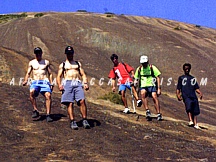
2. Sibebe Rock: Sibebe is the second largest rock in the world. It is exciting to climb the rock and experience the gorgeus scenic views at the top of the rock. The beutiful views encourages one to stay longer at the top.It is advisable to ask for a guide to assist climb the rock because it is not easy to climb down.
3. Bird Watching: Bird w atching can be one of the quieter and more relaxing outdoor activities. However, birders who are keen rarity-seekers will travel long distances to see a new species to add to the list of birds they have personally observed. Early morning is typically the busiest time of the day for birding since many birds are then at their hungriest, searching most actively for food, and thus are easier to find and observe. Success in locating the more interesting species typically requires detailed knowledge of their appearance, sounds, behavior, and most likely habitat, in addition to good measures of stealth and patience.
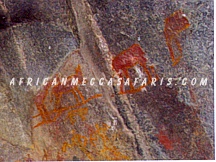
4. Nsangwini Rock Art: Bushman paintings offer a unique glimpse into a mysterious way of life shrouded in mystery that is between four hundred and four thousand years old. The top row of figures are in a trance dance and are entering the power world through a crack in the rock to their right. Bantu speaking people first arrived here in about 450 AD from the north, this is the only known Bushman painting of them with cattle and sheep in Swaziland. The caves was once the site of sacred rain making ceremonies. Access is along a mountained trail with trained guides to show the route and interpret the paintings. The Nsangwini Bushman paintings are managed and maintained by the Nsangwini community with a reservations, reception and orientation office at the start of the trail All profits from the scheme are reinvested in the community.
5. National Cultural Ceremonies In Swaziland – Incwala Ceremony: Traditional ceremonies are an integral part of Swazi life, despite the advent of modernisation. The most important of these is the sacred Incwala or “Festival of the First Fruits’. this is essentially a Kingship ceremony held to renew the strength of the King and the Swazi Nation for the coming year. Incwala is held in late December/early January of each year and, at a time of the new moon preceding the event, traditionalists visit the main rivers of Swaziland and return to the Nations ancestral home, on the shores of the Indian Ocean near Maputo, to gather sea water. At this time the King goes into seclusion. When the water gatherers return, and at the time of the full moon, the young men of the Nation congregate at the King’s residence. He orders them to march to Egundvwini that first afternoon of Ncwala, a distance of 40 kilometres, to gather branches of the lusekwane tree. They arrive, by mid-night, with the branches. As the youths rest, the elders use the branches to construct a sacred bower for the King alongside the Royal cattle Byre. The warriors of the nation assemble, dressed in special Ncwala costumes made of of ox hide and leopard skin. Ritual songs, which may not be recorded and which are taboo at other times of the year, are sung. A black bull is driven into the King’s bower and this animal is used for the mystic and sacred purposes of the ceremony. The King joins the warriors in dance on the fourth day and the Queen Mother and official guests attend. Only after the King has eaten part of a pumpkin may the Swazi consume newly-grown crops. No work is done on the fifth day which is set aside for rest and meditation. On the sixth day, firewood is collected for a massive bonfire on which articles are burned representing the year just past. To signify the start of a new year, the ancestral spirits are entreated to quench the bonfire with rain. The Ncwala ends with singing, dancing and feasting.
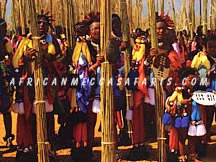
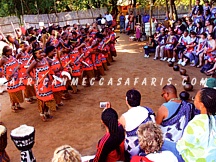
6. National Cultural Ceremonies In Swaziland – Umhlanga or the Reed Dance Ceremony: Umhlanga or the Reed Dance is held during a week at the end of August or early September. Swazi maidens, of marriageable age, gather at the Queen Mother’s residence and set out in parties to gather reeds. The reeds are used to repair the windbreak around the Queen Mother’s residence. The girls return by the fourth evening and spend the fifth day preparing their elaborate costumes for dancing. The singing and rhythmic dancing takes place on the afternoon of the sixth and seventh days at the Royal Vi llage. Photography is permitted at the Umhlanga, provided a permit is first obtained from the Government Information Office. There are other traditional ceremonies. At some of these events it is possible to witness lesser-known dances. However, the Sibhaca, imported together with the drum, from other Nations, is most popular amongst visitors for it’s stirring rhythms, dramatic movements and exciting colour.
7. Arts and Crafts: Undoubtedly one of the Kingdom’s greatest attractions, the art and craft outlets and traditional markets of Swaziland are a firm travellers favourite. Whether wanting a souvenir of an African holiday, a key decorative feature for a living room or office or maybe a special present for a love done back home, hours can be spent in the grip of Swaziland’s handcraft industry. Visitors to the kingdom of Swaziland will be delighted by the wide range of quality craftwork sold in specialists stores and roadside markets throughout the Country. A thriving handicrafts industry combines the best of traditional design and modern techniques and a stop at a roadside market will yield both a bargain and the opportunity of meeting the Swazi people. Wooden sculpture, painstaking soapstone carvings, glassware, mohair, tapestries, imaginative pottery, and silk-screened batik’s and clothing present an array of colours, textures and designs to tempt every pocket. And yes, Swaziland is indeed home to those world famous and unique works of art skillfully manufactured in front of your eyes by Ngwenya Glass and Swazi Candles. Buy right here from the source and be assured that not only are you getting the best deal possible, but that a percentage of money goes directly towards conserving Swaziland’s threatened rhino and elephant populations, a magnanimous gesture by these two organizations whose efforts may one day see real-life animals as numerous as the exquisite miniature specimens on their shelves.
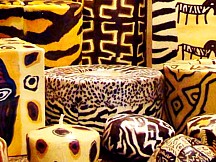
8. Swaziland Candles Workshop: The highly decorative Swazi Candles are hand-made in the small African Kingdom of Swaziland using the age-old technique “millefiore”. Millefiore, or “thousand flowers”, first surfaced in ancient Alexandria, but was perfected in the great glassmaking cities of Murano and Venice. Glass beads and other objects created there were of such beauty and finesse that they became much sought-after and valuable artifacts. On the African coast, these Venetian trade beads were used as a form of currency to barter for gold and ivory. So popular did they prove that the North and West Africans came to make their own variation. Thus was born the African trade bead, rare and sought-after by collectors to this day. The art of millefiore continues today in Swazi Candles. But instead of glass, the gifted candle makers of Swaziland use a special hard wax to create their colourful designs. The hard wax veneer forms the outer shell of the candle, which hardly melts when the candle is lit. Hence the rich, romantic glow of the illuminated exterior as the candle burns, and the burn-again quality when refitted with the votive or tea candle. (Mini sizes do not burn in this manner, yet retain their intrinsic value as works of Swazi craft.)
9. Nwenya Glass Factory: Started in 1979 by Swedish Aid. They built the factory, imported all the machinery and equipment and employed and trained Swazi’s in the age old art of glassblowing. Two of the most talented were sent over to Sweden to be trained by some of the leading glassblowers in the world. From 1981 to its closure in 1985, the factory was run entirely by Swazi’s.In June 1987, the factory was re-opened by Richard, Alix and Chas Prettejohn. Through sheer determination, hard work and common sense – and of course, invaluable assistance from Consol Glass, Talana – Ngwenya Glass now employs 70 workers, including 2 of the original blowers and 4 of the original other staff. Mr Sibusiso Mhlanga, who underwent advanced training in Sweden during the 70’s, has tutored new apprentices in the age-old art of glassblowing and has v isited Sweden a couple of times in the past few years to once again work with some of the leading glassblowers in the world. Sibusiso also assisted world renowned master glassblower, Jan-Eric Ritzman at Pilchuck Glass School in Seattle, USA in July 1998. The reason why Ngwenya Glass is so special is that only recycled glass is used – mainly old cool drink bottles, and that each and every piece is totally handmade and mouth blown. People from all over Swaziland collect bottles and are paid per kilo for clean glass. Ngwenya must be the cleanest area because any bottle that catches the children’s attention finds its way into the factory! Ngwenya Glass products are found in many homes worldwide, whilst custom-made light fittings and tableware are commissioned by the most prestigious hotels worldwide.